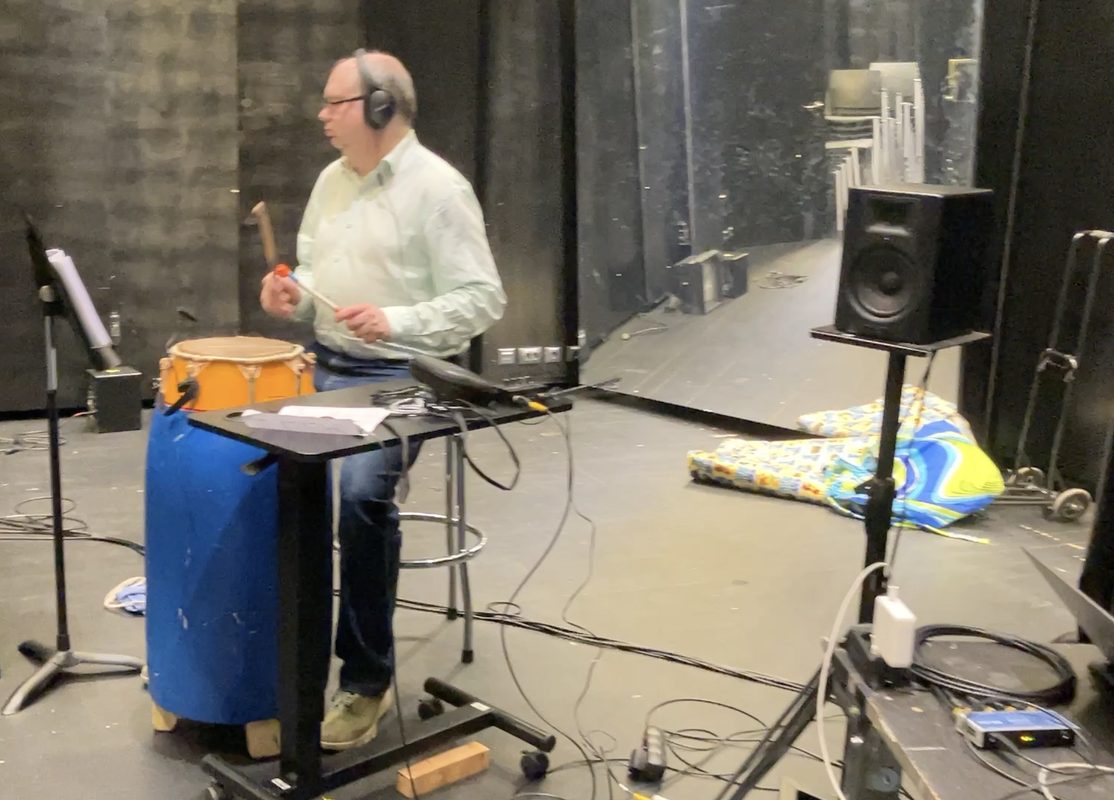

This article aims to explain the background of Hans-Gunter Lock's piece “Guards of the Night” for one percussion player with two Benin drums (ézinhoun and ôhungbo), live-electronics and fixed media in a spatial electroacoustical environment. This piece contains, in addition to diverse electronic sound processing of various drum sounds, passages of a traditional piece typical of the so-called Zangbeto ceremony, which was recorded ambisonically with the Zylia ZM-1 microphone.
Besides recordings from Benin, the author's 23-loudspeaker system and his approaches to spatial field recordings, which he made in Estonia and Finland, are also discussed. Three different fields of interest (3D spatial sound, western microtonality, especially the Bohlen-Pierce scale, and African rhythmic complexity) are shown with their reflections in the author's creative output.
“Guards of the Night” is inspired by the music played during the Zangbeto ceremony in West Africa. The Zangbeto were former night watchmen and policemen, and their souls live on in large conical straw masks. The magical masks dance and spin to the accompaniment of extremely fast music, sometimes they stop and when they are turned sideways everyone can see that there is no person underneath, everything is the power of ancient souls. Sometimes a surprise appears from under it, such as a small human figure or a smaller Zangbeto mask. When this large mask is upright again, it comes back to life and spins and dances on. In my work, the powerful and extremely fast music of this ceremony, played with rattles, five bells and several drums, is transformed into a different kind of mood in the context of electroacoustic sounds.