
§ 1.
Live Space 2026 happened from the 20th to the 26th of April. This has become a milestone of every year, and like on previous occasions, the experience is an extremely satisfactory, straining, challenging, and rewarding week’s worth of sounding, spatializing, thinking on, and through sound in space.
§ 2.
During this week in April, an international cohort of students, professional artists, lecturers, academics, and composers get together at the Music Innovations Studies Centre (MISC), at the Lithuanian Academy of Music and Theatre (LMTA). They share knowledge and work on spatial audio, culminating in a concert where the participating students showcase their compositions and performances resulting from an intense week of listening, exploring, and musicking.
The workshop/festival offers lectures by field experts on diverse topics that contribute to the overall idea of music and sound creation in a group setting using spatial audio technologies. As with every year, academics from Baltic and Nordic countries share their knowledge and experience (Table 2).
Spatial audio is a niche environment, ripe for state-of-the-art sonic creations that challenge technical limits while also engendering new aesthetic experiences using the spatiality of sound and movement as artistic gestures. In it, the very materiality of the medium comes to the fore, inseparable from the artistic intention. While non-spatialised sound-making, be it in music or the arts, traditionally arranges sound in time, the composition of space approaches the sound art field by giving new life to the primacy of arranging sound in space. The result is an engulfing experience that has the potential to transport the listener to an abstract physical space that momentarily modifies the perception of the reality surrounding the sweet spot.
§ 3.
The first interaction with this paradigm was a concert at the Lithuanian Theatre, Music and Cinema Museum, where Esther Calderón, Palle Dahlstedt, Jussi Tuohino, and Hans-Gunter Lock performed live electronic music on an octophonic system in an intimate setting, prying open the ears for immersive sound to come through the week. These performances ranged from pure electronic sounds/visuals to sounds of water and drums, or a drone-inducing robotic kantelė (kanklės in Lithuania, Baltic psaltery). Subtle details of the instruments moved across the speakers, enveloping the listening space and creating a texture across, with delayed layers in a motion that was sometimes physical as much as musical. This was an opportunity to see the lecturers themselves and their practices, as diverse as their sounds, yet converging in a spatial rendition of their output.
The day after continued with local artists’ barrage of masterful, lush ambient electronic sounds, using the 8th geometry as a playground for their in-situ experiments with improvisation, synthesis, spatialisation, and texturing. Edvinas Siliūnas played with recordings from his Senegal trip, exploring different re-sampling possibilities in a dark, multichannel environment. Domantas Pūras used his knowledge and skill with analog synthesizers to create an ambience of semi-improvised performance.
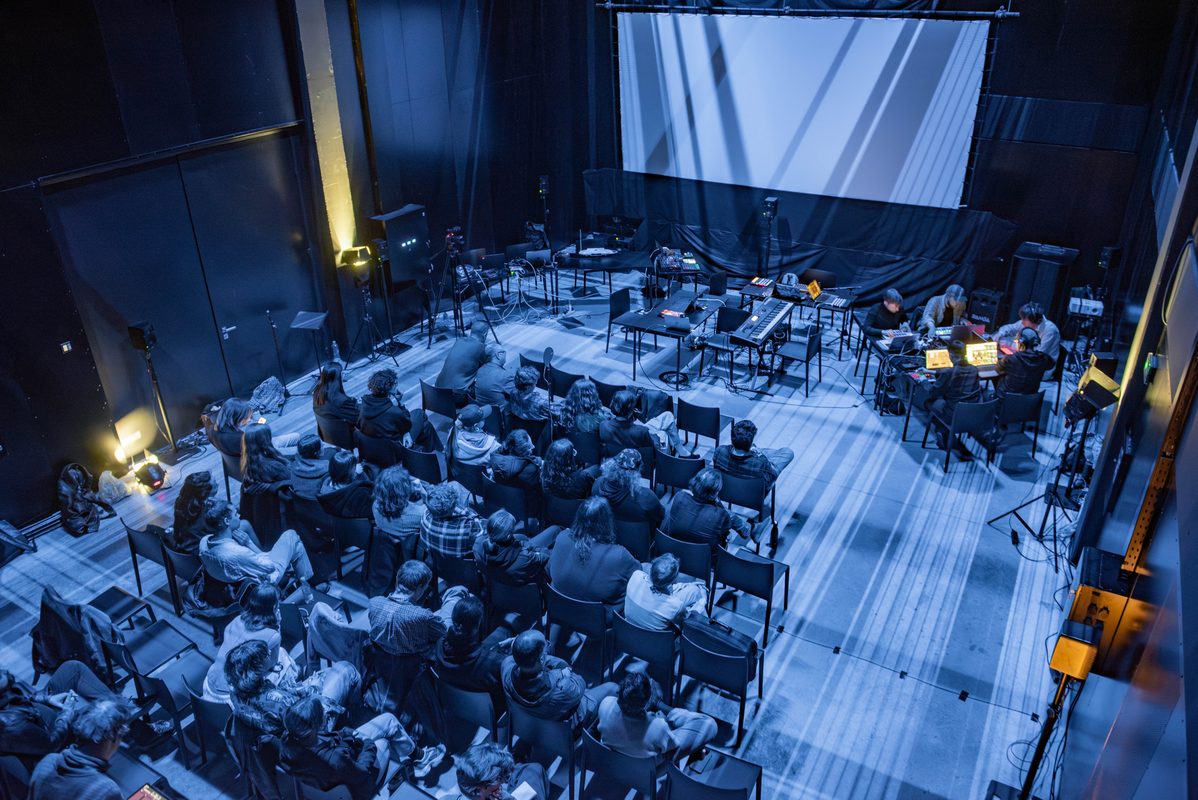
On the final days, the concert venue was the LMTA - KIMO Small Film Pavilion. Highlighting a semi-industrial (however clean academic) look, with a ceiling height of around 10m, this is one of those spaces that are ideal for this type of sonic empiricism. Listening changes here: the volume allows for the spatially materialized sounds to travel, breathe, and induce a perception of waveforms and the space itself that more than one person in the audience had not experienced before; and will not for a long while. While not as large as one would wish for the occasion, and within a repurposed, clean cinema-slate context, the space served the purpose of amplifying the sonic ideas, giving them breadth in volumes.
§ 4.
The downpour of knowledge, experience, and the mere presence of the visiting teachers, academics, composers, and experts puts the cohort in a privileged moment where all international participants speak the common language of spatial audio, music, and performance. Guest lecturers brought well-known figures of the Northern European spatial scene, along with new faces engaging in presentations that ranged from technical plugin descriptions and development to reflections on composition, space, and artistic gesture.
Inspired by these lectures, students worked in groups to prepare content for a weekend concert, whilst also enjoying a cultural program of concerts by the lecturers themselves, local composers and performers. The week offered little respite, with a constant stream of content, information, and mentoring focused on the accomplishment of the final works.
§ 5.
Clearly, the center of attention shifted towards the creations by the workshop participants. Students with diverse profiles (composers, performers, and music technologists), together delivered four performed spatial audio acts and one fixed media piece encoded in Ambisonic B-format:
- Group 1, “The Sightseers,” provided an electroacoustic improvisation using computers, a theremin, modular synths, and even a bowl full of water.
- Group 2 (name?) combined sounds from their personal libraries of recordings, connecting backgrounds with experiences, meta-performance, and interaction with the audience via a webcam.
- Group 4, “pRiMaLs,” focused on language, the materiality of its sound, and worked with primal number utterances in different languages.
- Group 5, “The Ambidextrousaurus” walks a thin line between humor and exploration of sound matter, trying to develop a more varied diet, but having a really hard time. Interdisciplinary electroacoustic performance with dance and theatrical elements.
- Group 3, “What Comes After the Rain?” was a fixed media piece made from electromagnetic recordings.
These acts moved from electronic instrument and synthesizer sound swirling across and around the audience, in patterns that drew attention to the architectural features themselves, and back to the sounds. The patterns in the waveforms became entangled with the lines of the physical space, and were heard with new life, different to that planned for in the headphones of the MISC studio.
At times, one’s attention would shift from the swelling effect of the theremin, or the electronic textures of synthesizers and recordings, to their position in the space, and to the perceived question of who and how this was being done, before returning again to emerging melodies from electronic devices. Voices flew across the room, their meaning partially lost in translation, revealing sonic properties, through both of their own nature and their location and interaction with the acoustics of the space.
When this mobility was taken to the extreme, new tones emerged. Sound sources moved fast, and the movement became a sound source in itself. And just as the ears got used to that, a theatrical performance put an unexpected end to the night.
§ 6.
The very process that conducted these pieces is also the moment and ambience a workshop like this aspires to foster. Students self-organizing, finding routes for collaboration, searching for the group genius, knowing themselves through the creative process, and navigating technical and artistic conundrums. A witness of the week would see an Innovation Centre in disarray: cables on the floor, synthesizers at mid patching, last minute trouble-shooting and teams testing ideas in the time windows provided. But to those involved, this attests to the engagement of the artists in a mission to spatialize their visions.
Friday’s concert also starred our colleague and part of the LiveSpace team, Matas Samulionis’s Doctor of Arts defense performance. An act that left everyone in awe of the extent to which a combination of conditions, skill, research, technology, and a conscious and organised quest for knowledge can produce artistic activities of the depth, layering, and mastery that Matas demonstrated. During his performance, a voltage surge caused a momentary reset of the sound system, computers, and his live devices. However, this only added to the display of finesse, as few people noticed that anything had happened at all, while Matas continued to improvise in line with the planned structure of his program.
§ 7.
It would seem that the contribution of the week to sound culture is not only to the participants, but also to the hosting venue, team, and local scene. Creating a tradition, a scene, and a regional hub of spatial audio activities, the community grows and becomes acquainted with avant-garde and experimental concepts, technologies, and ways to spatialise ideas. The composition of space leaves a mark in the collective imagination and local memory of the art-making of this time and the people who inhabit it. Also importantly, it creates working relationships between partners and participants, that continue after the workshop.
Every iteration of these workshops introduces challenges to the established aesthetics of the field: a quiet movement towards the innovation of sound-making practices. Not limited to a musical sense, but material and artistic as well, the tradition accumulates and finds new ways to articulate ideas through spatial gestures, with the help of improved audio technologies. The community gradually becomes a steward of this practice.
§ 8.
As expected, not everything is was smooth. Even though successful, the concentration of people, knowledge, cultures, and artistic expressions throughout the week came with a few rough edges. However, hiccups in logistics, communication, promotion, and the technical priming of students are added to the to-do list and must find their way into upcoming incarnations of the workshop.
One important point to document is the continuous scouting for venues: acoustic and architecturally compelling options that would take a frontal role in the sound-making processes of future iterations. Spatial audio benefits from spaces of large volumes, complex and special architectural characters.
§ 9.
Another footprint was laid in the memory of the sound community and, more clearly, spatial sound culture. This inertia has left a strong and long-lasting impact on all involved, and on the local, national, and regional soundscape. Participants are colleagues and friends. A growing context of spatial audio artists is left with the effect they contributed to, but also with what they carry onto their ongoing practices.
By the end of the week, the work done, the sounds explored, and the hours invested in creating, linger as a reverb, long after the concerts are finished. Further evolutions of the format, venues, technology, aesthetics, and artworks are what is coming for the now relabeled Sonosphere 2027.
Full list of participants:
- Mikael Maliks University of Bergen / Grieg Academy
- Aila Ahmakallio Oulu University of Applied Sciences (OAMK)
- Katrīna Akmentiņa Estonian Academy of Music and Theatre (EAMT)
- Yanina Aspenkjær Royal Academy of Music, Aarhus
- Laban Bettels Norwegian Academy of Music (NMH)
- Iosif Dombrauskas Lithuanian Music and Theatre Academy (LMTA)
- Þórbergur Bollason University of Bergen / Grieg Academy
- Marcus Lukkarila Oulu University of Applied Sciences (OAMK)
- Alice Armando Sibelius Academy / Uniarts Helsinki
- Leon Saar Academy of Music and Drama, Univ. of Gothenburg
- Torbjørg Fykse Wesnes Norwegian (independent — Kollektiv, Oslo)
- Erik Håkon Halvorsen University of Bergen / Grieg Academy
- Maija Christina Pospiech Oulu University of Applied Sciences (OAMK)
- Ching Jo (Heu) Hsu Aalto University (Helsinki)
- Freya Karina Wolf Malmö Academy of Music
- Elija Kuniskytė Lithuanian Music and Theatre Academy (LMTA)
- Yui Ka Zheng Estonian Academy of Music and Theatre (EAMT)
- Oskar Björkman Malmö Academy of Music
- Lauri Marjakangas Sibelius Academy / Uniarts Helsinki
- Laurynas Kamarauskas LMTA
- Jakob Malmfors Academy of Music and Drama, Univ. of Gothenburg
- Aslak Meling Norwegian Academy of Music
- Alissija Jevtjukova Estonian Academy of Music and Theatre (EAMT)
- Ian Whiteford Malmö Academy / Lund University
- Antti Roope Hautamäki Oulu University of Applied Sciences (OAMK)
- Ksenija Gembickaja Academy of Music and Drama, Univ. of Gothenburg
- Justinas Stirblys Lithuanian Music and Theatre Academy (LMTA)
Full list of guest lecturers
- Jussi Tuohino Oulu University of Applied Sciences, Finland
- Alejandro Olarte UNIARTS/ Sibelius Academy , Finland
- Palle Dahlstedt Gothenburg University / Academy of Music and Drama , Sweden
- Hans-Gunter Lock Estonian Academy of Music and Theatre, Estonia
- Anders Tveit Norwegian Music Academy , Norway
- Morten Det Jyske Musikkonservatorium
- Stylianos Dimou University of Bergen, Faculty of Music
- Joakim Barfalk Malmö Academy of Music, Lund University
- Lora Kmieliauskaite Lithuanian Music and Theatre Academy, Vilnius, Lithuania.
- Matthias Kronlachner Lucid Motors, Newark, USA. Vilnius. Lithuania.
Detail of lectures:
- Matthias Kronlachner [AT/LT] — Ambix and mcfx revived - how to tame large number of speakers and microphones
- Lora Kmieliauskaite [LT] — Looking for Group Genius
- Esther Calderón [ES/FI] — (Basic) strategies for performing the space
- Palle Dahlstedt [SE]— Strategies for live electronics performance
- Hans‑Gunter Lock [DE/EE]— Guards of the Night
- Jussi Tuohino [FI] — An Ambisonic Live Practice
- Morten Elkjær [DK] — Ambisonics technology, tools for recording and mixing in Reaper
- Stylianos Dimou [GR/NO]— Spatial Hybridity and Convolutional Topologies in Live Electroacoustic Practice
- Anders Tveit [NO] — Spatial‑Sound‑Toolkit_for_Max v2.0
Organisation team:
- Rima Rimšaitė - Head of International Office.
- Domantas Pūras - Senior specialist, International Office.
- Mantautas Krukauskas - Head of Music Innovations Studies Centre.
- Matthias Kronlachner - Sound Engineer.
- Matas Samulionis - Researcher, Lecturer.
- Roberto Becerra - Lecturer, Developer.
Photo: Tomas Terekas